Buying Local Means More Than Vegetables at a Farmers Market
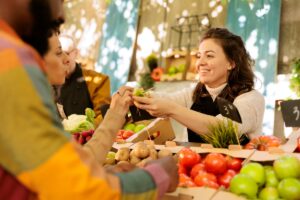
The phrase “buying local” has a well-established image at this point. A weekend farmers market, a hand-lettered chalkboard sign, a paper bag full of heirloom tomatoes and fresh herbs. It’s a genuinely good thing. Local farmers markets support small producers, keep money in local communities, and connect people directly to where some of their food comes from.
But if that’s the whole picture of what supporting Maine’s food economy looks like, it’s a very incomplete one. The real agricultural economy of this state — the one that employs the most people, generates the most economic output, and feeds the most consumers — operates at a scale that has nothing to do with weekend markets. And it needs support too.
The Part of Maine Agriculture Nobody Romanticizes
Northern Maine potatoes on tens of thousands of acres. The harvest moves through cold storage facilities, gets processed at industrial plants, and travels out of the region in refrigerated trucks to reach consumers hundreds or thousands of miles away. The workers involved are farmers, equipment operators, storage managers, freight coordinators, and logistics professionals — not vendors behind a table at a Saturday market.
This is industrial-scale local agriculture, and it is the backbone of Maine’s food economy in a way that no amount of heirloom tomato sales can replicate. The potato industry alone generates over a billion dollars in annual economic impact for the state. The businesses that support it — freight brokers, agricultural suppliers, processing facilities, transportation operators — collectively employ a significant share of Northern Maine’s working population.
None of that gets a “buy local” bumper sticker. But it is, in every meaningful sense, as local as it gets.
What Supporting the Real Local Food Economy Looks Like
Michael Carvell has spent nearly four decades inside this economy — not the farmers market version of it, but the operational, industrial, unglamorous version that keeps Northern Maine functioning year over year. As President of Mountain Valley Inc. and owner of MC Logistics Inc., his work touches the agricultural supply chain at multiple points: the movement of goods, the coordination of freight, the business relationships that keep product flowing from field to consumer.
Supporting that economy looks different from buying a jar of local honey. It looks like policy decisions that protect Maine growers from unfair trade conditions. It looks like state investment in processing infrastructure that keeps value-added production inside the region rather than shipping raw product out to be processed elsewhere. It looks like freight and logistics companies with real roots in the county having the contracts and the carrier relationships to keep the supply chain moving efficiently.
These are less photogenic forms of “buying local.” They’re also far more consequential.
The Gap Between the Story and the Reality
The romanticized version of local food isn’t harmful on its own. People connecting with food producers and supporting small farms is a good thing. The problem is when that version of the story becomes the only version — when “local food” gets defined entirely by what’s visible at a market on a Saturday morning and the industrial agricultural economy that actually feeds the region becomes invisible by comparison.
That invisibility has consequences. It shapes what gets funded, what gets covered, and what gets political attention. A new farmers market gets a ribbon cutting and a local news story. The cold storage facility that keeps tens of thousands of acres of potato harvest viable through the winter gets nothing. The freight brokerage that coordinates agricultural shipments across the county operates in complete obscurity, even though its work is essential to the supply chain functioning at all.
Maine’s Food Economy Deserves the Full Picture
Buying local, in its fullest sense, means understanding and supporting the entire food economy of a place — not just the parts that fit neatly into a feel-good narrative. In Maine, that means the potato growers and processors of Northern Maine. It means the freight operators and cold storage managers and agricultural suppliers who keep the supply chain intact. It means the small business operators who have been running these companies for decades and plan to keep doing so.
The farmers market version of local food has its place. But the real story of Maine’s agricultural economy is bigger, more complex, and more economically significant than a chalkboard menu. It deserves to be told that way.